The Role of Police Cars
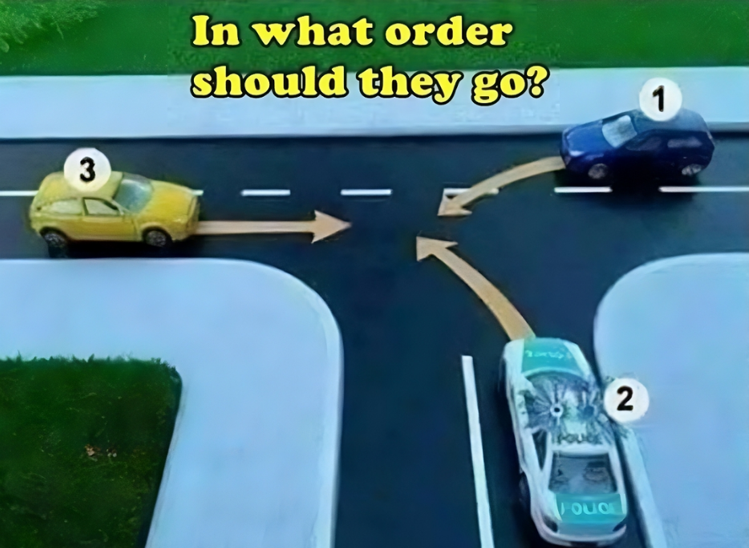
In our scenario with a police car and two civilian vehicles, how do we determine the order of movement?
When a police car is present, the situation changes. According to traffic laws, emergency vehicles have the right of way when their sirens or lights are activated. Therefore, if the police car is using its sirens, it must go first.
However, if the police car is silent, it must follow the same rules as other vehicles and yield when necessary.
Opinion: Police Car Goes First
Some believe that if the police car honks, it signifies duty, and they must proceed first. This viewpoint makes sense as emergency vehicles often respond to critical situations. In this case:
- The police car (with siren) goes first.
- Car number 3 (going straight) follows since vehicles traveling straight have priority.
- Car number 1 (turning left) goes last, as left-turning vehicles must yield to those going straight.
This order aligns with standard road rules and the specific intersection conditions.
Alternative View: No Siren, No Priority
Another perspective considers when the police car isn’t using its sirens. Here, the police car has no special privileges and must obey regular traffic laws. According to this view:
- Vehicles on the main road must yield to those on the crossroad.
- Car number 3 (going straight) has priority to go first.
- Car number 1 (turning left) follows, yielding to the vehicle going straight.
- The police car (without siren) goes last.
In this scenario, the police car must yield unless responding to an emergency.
Driving Test Principles
Many drivers base their decisions on principles learned during driving tests, which emphasize the role of emergency vehicles and vehicles traveling straight. According to this viewpoint:
- The police car (on duty) is the priority vehicle and goes first.
- Car number 3 (going straight) follows.
- Car number 1 (turning left) goes last because left-turning vehicles yield to straight-moving cars.
This approach simplifies the order while prioritizing emergency services.
Intersections Without Signs
At intersections without road signs or traffic lights, drivers rely on understanding equal rights. In such cases, the order of vehicles is determined by who arrives first and general traffic courtesy.
If no traffic lights or signs are present, the order might be:
- The police car (if siren is on) goes first.
- Car number 1 goes next, having arrived first.
- Car number 3 moves last, arriving after the others.
This order is based on right-of-way principles in the absence of external signals.
Conclusion: Determining the Right Order
After examining various opinions and principles, the likely answer is:
- The police car (if on duty) goes first due to its priority as an emergency vehicle.
- Car number 3 (traveling straight) follows.
- Car number 1 (turning left) goes last since left turns yield to straight-moving traffic.
This sequence—police car, car number 3, car number 1—aligns with most traffic laws. However, remember that local regulations may vary, so always refer to specific rules in your area when approaching intersections.
In conclusion, understanding right of way is crucial for road safety. When a police car is involved, it generally has priority to proceed, especially if on duty.